How high should you hold that kettle? Scientists have finally found an answer—and it may surprise you.
BY BHAVI PATEL
BARISTA MAGAZINE ONLINE
Featured photo by Julien Labelle
Every barista knows the ritual: the careful concentric circular pour, the blooming grounds, that satisfying first sip. But here is something most don’t know: The height from which you pour your water might be just as critical as your grind size or water temperature. A groundbreaking study published in Physics of Fluids this past April has cracked the code on pourover extraction, and it is about to change how we think about brewing coffee.
The Science Behind the Stream
In a study published last spring, researchers at the University of Colorado in Boulder, Colorado, dove deep into the physics of pourover coffee, examining what happens when a water jet hits a bed of coffee grounds. Their findings reveal something counterintuitive: Pouring from greater heights does not just add drama to your brewing routine—it fundamentally alters the extraction process.
The study explored the complex dynamics at play when water impacts granular beds of coffee. As the stream descends from higher elevations, it gains velocity and kinetic energy. This increased force creates what researchers call “avalanche dynamics” within the coffee bed, essentially causing more aggressive mixing and movement of the grounds during extraction.
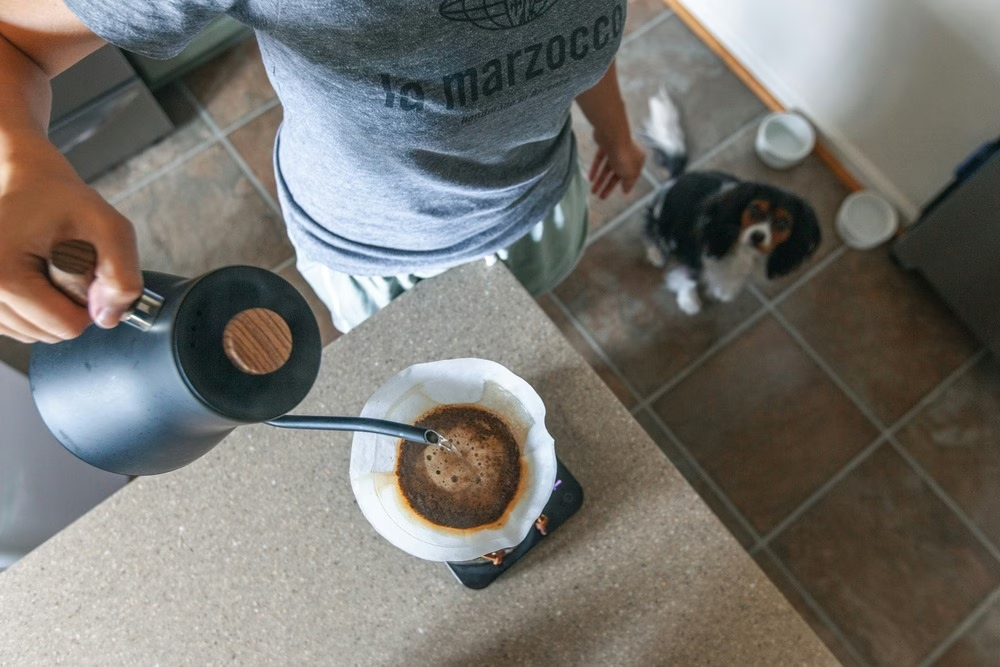 Researchers at the University of Colorado recently found that greater pour height creates “avalanche dynamics” within the coffee bed, or more aggressive mixing and movement of the grounds during extraction. Photo by Kayla Phaneuf.
Real-World Applications for Coffee Professionals
For industry experts, these findings open up fascinating new possibilities. Ankur Gupta, co-founder of Curators Coffee in Jetalpur and Sarabhai, India, sees immediate practical applications. “The study helps us get a better understanding of extraction parameters,” Ankur told Barista Magazine. “There is a definite shift in extraction when pouring from a higher point.”
This is not just academic curiosity—it is actionable intelligence for baristas and home brewers alike. Ankur points out specific scenarios where pour height becomes especially valuable: “This will be especially useful while brewing pre-ground coffee for home brewers, or when we are brewing from a coffee bag that has been opened for more than a couple of weeks.”
The implications make sense. Stale or pre-ground coffee has already lost some of its volatile compounds and aromatic oils. By adjusting pour height, brewers can compensate for diminished freshness, extracting more effectively from beans that are past their “prime.”
Beyond the Basics: Roast-Specific Techniques
Perhaps most intriguing is how pour height could become another variable in the barista’s toolkit, alongside grind size, water temperature, and brewing time. “The study also enables us to explore better brewing techniques using pour height as a variable along with dosage for light and dark roasts,” Ankur says.
Light roasts, with their denser structure and harder beans, often require more aggressive extraction to unlock their complex flavor profiles. Dark roasts, being more porous and soluble, extract more readily. Could adjusting pour height provide a simple mechanical solution to optimizing extraction for different roast levels? The research suggests yes.
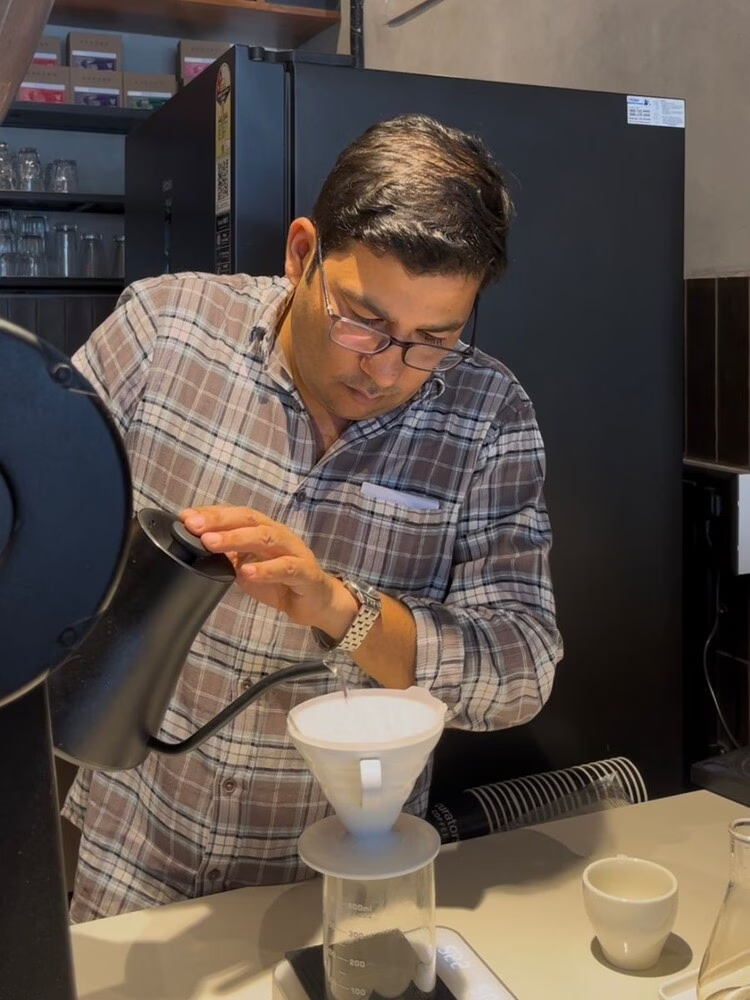 “The study also enables us to explore better brewing techniques using pour height as a variable along with dosage for light and dark roasts,” says Ankur Gupta of Curators Coffee in India. Photo courtesy of Ankur Gupta.
Mixing Matters—More Than You’d Think
The study’s focus on mixing dynamics reveals why pour height matters so profoundly. Coffee extraction is not just about water passing through grounds; it is about how thoroughly and uniformly that water interacts with every particle. Higher pours create more turbulent mixing, potentially leading to more even extraction and fewer under-extracted pockets within the brew bed.
This challenges the conventional wisdom that gentle, controlled pours are always superior. Sometimes, physics tells us, a little chaos yields better results.
The Future of Pourovers
As specialty coffee continues its evolution from art to science-informed craft, studies like this provide the evidence-based foundation for innovation. Pour height joins brew ratios, extraction percentages, and total dissolved solids as measurable, adjustable parameters that professionals can manipulate for optimal results.
The next time you are brewing that morning cup, consider the physics at play. That kettle height is not just about aesthetics or wrist comfort—it is about harnessing kinetic energy to unlock flavor. Science has spoken, and it is telling us to pour with purpose.
ABOUT THE AUTHOR
Bhavi Patelis a food writer focusing on coffee and tea, and a brand-building specialist with a background in dairy technology and an interest in culinary history and sensory perception of food.

Subscribe and More!
As always, you can read Barista Magazine in paper by subscribing or ordering an issue.
Support Barista Magazine with a Membership.
Signup for our weekly newsletter.
Read the December 2025 + January 2026 Issue for free with our digital edition.
For free access to more than five years’ worth of issues, visit our digital edition archives here.
The post New Study Shows Why Pour Height Matters appeared first on Barista Magazine Online.