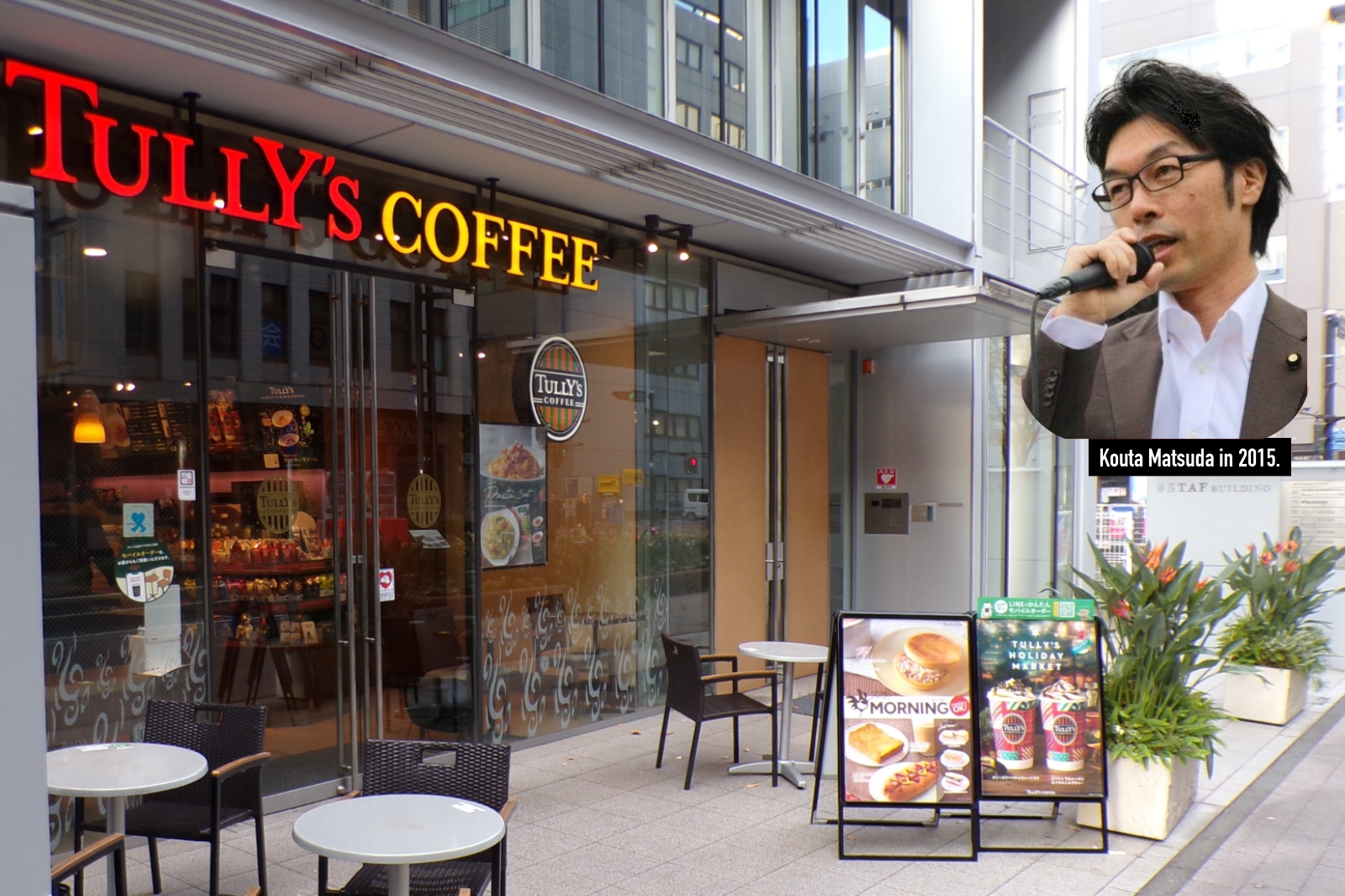
It’s no longer possible to walk into a Tully’s coffee shop in the United States.
Originally founded by real estate developer Tom “Tully” O’Keefe in 1992, Tully’s expanded to around 135 cafes, most of them in Washington state and California, before filing for bankruptcy in 2012. A handful of cafes in the Seattle area survived until March 2018, when the last cafe closed for good. Their American brand presence continues in branded Keurig cups and bagged coffee.
This was not the original vision O’Keefe had when he opened his first store. He believed Tully’s would eventually rival Starbucks, but due to missteps and economic downturns it was never able to reach such competitive heights.
Still, he tried. Back in 1996, the Seattle Times described the silver-haired O’Keefe in jest as having “a Starbucks complex,” a mindset he seemed to have embraced. When the newspaper went to interview him, they discovered that he had moved Tully’s roasting plant into the same Seattle facility Starbucks once used.
O’Keefe only needs to fly to Tokyo to see that Tully’s, with more than 800 cafes across Japan, does stand somewhat as a rival to Starbucks (just over 2,000 cafes).
Tully’s in Japan only lives on as a cafe due to the efforts of a young, ambitious Japanese man, Kouta Matsuda, who loved challenges. One of his favorite proverbs, communicated by his father, was: “When young, one should be willing to pay money to go through hardship.”
In Boston for a wedding
In December 1995, Kouta Matsuda, a 27-year-old Sanwa Bank employee, traveled to Boston to attend his friend Jeff Farris’ wedding. He and Farris had kept in touch since meeting each other in high school, and it was in 1994 that Farris — seeing the surging popularity of gourmet coffee shops in America — encouraged Matsuda to open one of his own in Japan.
America was no stranger to Matsuda. Born in Miyagi Prefecture and at the mercy of his father’s fisheries company transfers — they even lived in Dakar, Senegal for five years — young Matsuda spent half his childhood in Lexington, Massachusetts.
“I worked as a newspaper boy delivering the Boston Globe for two years, starting in the final year of elementary school,” Matsuda told Juro Osawa of the Wall Street Journal back in 2007. “I delivered the paper to 60 or 70 households by bike. Getting up at 5 every morning was hard, especially in the middle of winter.”
The idea of hard work paying off started to settle into his mind.
“I also made a little money as a kid by mowing neighbors’ lawns, selling lemonade, holding a garage sale, and so on.” Matsuda admitted that these moments were because of the Western culture around him. “If kids growing up in Japan tried to do that, parents or schools would probably stop them and tell them off, but it wasn’t unusual in the U.S. I think I owe my entrepreneurship partly to those early experiences.”
"When young, one should be willing to pay money to go through hardship." —Kouta Matsuda
It was in Boston for Farris’ wedding where Matsuda first fell in love with the taste of specialty coffee.
“I used to drink coffee like smokers smoked cigarettes,” Matsuda told Tetsushi Kajimoto of the Japan Times back in 2001. “Like at times when I was working on a report [at Sanwa] and could do with a little something to keep my mouth busy.”
After the wedding the idea of the specialty coffee industry kept brewing in his mind. Knowing as many did at the time that gourmet cafes were growing quickly in the Pacific Northwest, he headed to Seattle, America’s specialty coffee capital.
In the mid-90s there were numerous coffee chains hoping to ride the coattails of the Starbucks boom. Along with the green-and-white siren of Starbucks (which opened a location in Ginza in 1996), Seattle’s Best Coffee (35 stores), Caffe Appassionato (8 stores)and Tuscany Cafe (25 stores) would have been on Matsuda’s radar at the time.
Matsuda, enjoying his time away from Sanwa, tried as many shops as he could— at least 50, he recalled once. But upon entering one of the 10 Tully’s cafes in the Seattle-area, he was spellbound. After taking in the ambiance, branding and quality of the coffee, he believed he could open a Tully’s in Tokyo.
From this point, Matsuda started reaching out to Tully’s corporate headquarters. He called, emailed and wrote, inquiring about opening a Tully’s in his home country. He did not receive much of a response until he was told that O’Keefe was at a hotel in Tokyo. Matsuda went there “immediately,” he said in a 2008 interview in Japanese with Rikunabi writer Chihoko Takashima. “After that, I continued to negotiate several times and was able to obtain management rights in Japan.”
Finding the money

Now that he had the rights, he needed capital. He’d saved somewhat from his five years at Sanwa, but opening a business in Tokyo meant securing a massive loan. Matsuda had some advantage, since he understood the dynamics of bank loans after working at one for several years.
“The start-up capital was ¥70 million,” he told Takashima. “I borrowed ¥35 million from the Financial Corporation and collected the rest from friends and relatives. Of course, I was worried. It was the first time I had borrowed such a large amount of money.”
As for the location, Matsuda eyed Ginza, as McDonald’s had done back in 1971. Opening in Ginza, known across Japan as the country’s luxury goods hub, meant a better chance at success. Unfortunately for Matsuda, the area he wanted was not available, so he plunked down about ¥3 million for a spot in Hiroo, 20 minutes from Ginza by train.
Matsuda needed to work quickly, but soon after he’d made the initial payment for the Hiroo shop, the Ginza spot became available. Later, he told Osawa that it was the hardest decision he ever made.
“If I wanted to apply for the new place, I had to give up the 3 million yen I had paid for the other place. I was already in debt after raising the capital to start this business. And I wasn’t 100 percent certain that the Ginza place would be ours if we applied. There was a risk of losing both. Ginza’s rent was higher but it had more potential, as the area is more vibrant than Hiroo. In the end, I went for the bigger challenge and chose Ginza.”
A prime store location did not lead to sales, however. The first three months were an absolute grind, and Matsuda lost so much money he sold his computer to help cover costs. Desperate, he composed a handwritten letter, made dozens of copies and walked into all the neighborhood offices that allowed him entry. He handed out the letter, “inviting workers to visit,” the Oregonian reported in 2002. He had resorted to near begging, but it was the only card he had left to play.
It's unknown how well this ploy worked, but what happened next was far more important.
According to a 2011 case study by Armand Gilinsky Jr. and Wakako Kusumoto in the compelling book, Comparative Entrepreneurship Initiatives: Studies in China, Japan and the USA, it was venture capitalist Hitoshi Suga who helped lift Matsuda from a one-off hipster cafe in Ginza to a nationwide brand. Suga had seen brief mentions of Tully’s in newspapers, and part of his job at Mitsui was to find prospective businesses with potential upside. One day, Suga’s assistant encouraged him to go to Tully’s — perhaps after receiving the photocopied letter — so he did. When he ordered, Suga asked to speak to the person in charge. Matsuda nodded.
Suga wanted to talk, so Matsuda asked if they could sit outside to make the place look a bit busier, even though it was cold. During the two-hour conversation, Suga measured up the business owner in front of him. He learned that Matsuda “basically lived in his shop in order to cut down on commuting time,” and that his background had led to an “optimistic and persistent” work ethic. Suga came away impressed by his “vision and commitment.” Did Matsuda want to grow his business? The answer was clear: Absolutely.
Armed with Mitsui capital, Suga “invested seed money of ¥30 million and researched future prospects of coffee shops in Japan.” Confident that Matsuda could navigate Tully’s safely into the competitive market already flooded with Starbucks, Doutor and Excelsior, Suga helped build an expansion plan. Thirty months after opening in Ginza, Tully’s Coffee Japan went public, “raising ¥1.2 billion, which allowed the company to expand approximately 300 shops throughout Japan.”
Five years later, in October 2006, Ito En took over majority ownership of Tully’s, and since then the 823 Tully’s locations have remained competitive with Starbucks (2,041), Doutor (1,285) and Komeda Coffee (1,055).
Quick fact
Since 2002, Starbucks Japan has not allowed smoking in their cafes. Tully’s, aiming to differentiate itself from Starbucks, has kept most of its smoking sections, constructing rooms with advanced ventilation.
Next in the series will be how Tokyo Disneyland opened in 1983.
Other stories in "When They Opened in Japan"
Patrick Parr is professor of writing at Lakeland University Japan. His third book, Malcolm Before X, published by the University of Massachusetts Press, is now available. His previous book, One Week in America: The 1968 Notre Dame Literary Festival and a Changing Nation is available through Amazon, Kinokuniya and Kobo.
© Japan Today