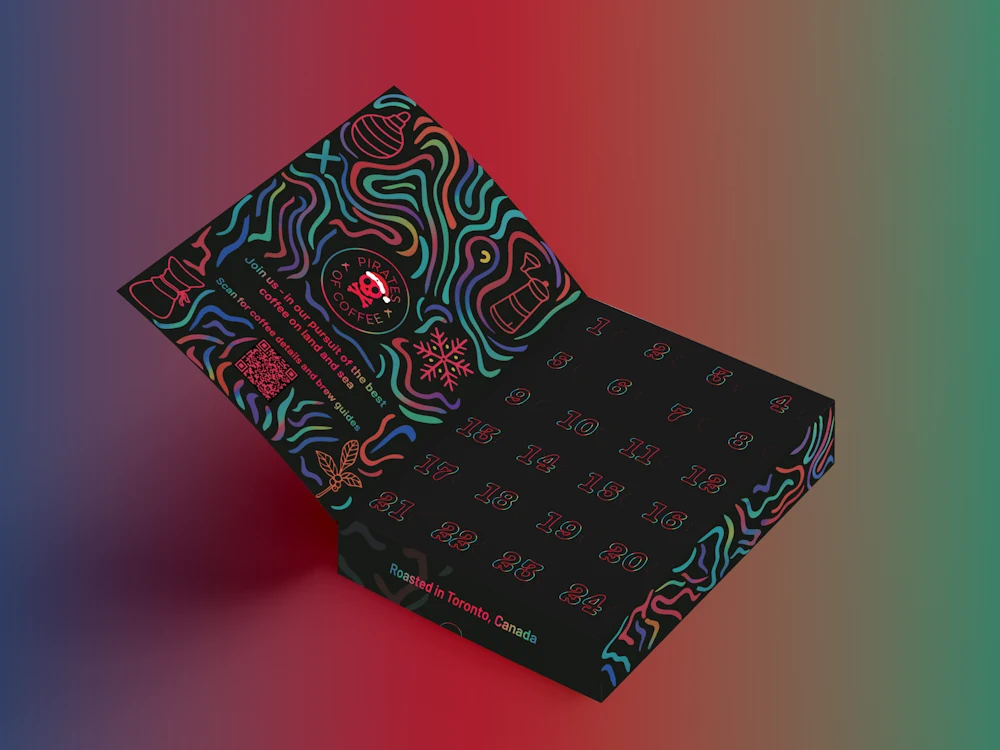
- Coffee advent calendars are a growing seasonal trend that allow roasters to showcase a wide range of coffees in one product.
- As the luxury advent calendar trend continues, coffee calendars offer the excitement of “daily discovery” and ritual.
- Each calendar can include up to 25 different coffees, meaning roasters must start developing them well in advance.
- Although they’re a unique opportunity for consumers to try many different origins, processing methods, and flavour notes, advent calendars pose several logistical challenges, including packaging design.
More and more roasters are launching coffee advent calendars. Tapping into the growing “luxury” advent calendar trend, roasters like Onyx Coffee Lab, Grind, Pact, Pirates of Coffee, and more design their own every year.
They have become a staple seasonal product in the coffee industry, allowing roasters to showcase up to 25 coffees at a time. Each day in the lead-up to the holidays starts with a different coffee, offering daily flavour discovery that actively engages consumers.
Coffee calendars are an opportunity for roasters to flex their creative muscle, but developing one comes with a number of logistical challenges – from maintaining coffee freshness to designing intricate packaging.
To learn more, I spoke to Will Corby at Pact Coffee and Abbas Alidina at Pirates of Coffee.
You may also likeour article on choosing the right specialty coffee gift.

Why coffee advent calendars are becoming so popular
Originating in 19th-century Germany, advent calendars are a traditional way to count down to the holidays, typically running from 1 December to 24 or 25 December. They feature a compartment, flap, or door for each day that reveals a small gift or surprise.
The first commercial calendars, which typically included chocolate, were developed in the 1950s. But today, they can include beauty products, small toys, coffee, tea, and alcoholic beverages.
Driven by the popularity of “unboxing” social media content (a cost-effective marketing tool for luxury brands), premium advent calendars have become a lasting trend. In 2021, fashion house Chanel released its first-ever advent calendar to celebrate the 100th anniversary of its iconic Chanel No. 5 perfume, which quickly went viral.
In the years since, more specialty coffee roasters have tapped into the trend, designing their own calendars to offer between 12 and 25 different coffees. Some opt for a 24 or 25-day version to maximise variety, but most prefer a 12-day format to make product development more manageable.
“Our advent calendar features 25 different coffees, which is a very exciting way to introduce customers to the incredible range of flavours and characteristics in specialty coffees from around the world,” says Will, the director of coffee and social impact at the UK’s Pact Coffee.
“The goal is to show customers, some new to specialty coffee, as many unique natural flavours as we can, whether that’s chocolate praline, strawberry cream, or candied plums,” he adds. “As a long-standing UK tradition, Advent has been a particularly thoughtful and engaging way for us to do this, and when it involves incredible coffee, it can genuinely benefit the wider industry.”
As demand for luxury advent calendars continues to grow, tapping into “little treat” culture, coffee calendars offer the excitement of “daily discovery” and ritual, appealing to a wide range of consumers, not just specialty coffee enthusiasts. In turn, they are becoming effective marketing tools for roasters.
“It gives customers a reason to think about your brand 24 days in a row,” says Abbas, the founder of Toronto’s Pirates ofCoffee. “If a roaster approaches it as ‘just a cool box’, it might feel like a stressful one-off project.
“But we see it as an annual flagship experience with good planning, storytelling, and follow-up. Our advent calendar has become a core part of our brand and holiday season.”

How can roasters develop them?
Although they’re a unique opportunity for consumers to try many different origins, processing methods, and flavour notes, advent calendars pose several logistical challenges.
Despite being a seasonal product, planning a coffee advent calendar often requires year-round preparation. This gives roasters time to source their coffees, tweak packaging designs, and coordinate marketing strategies.
“Planning takes the whole year, if not longer,” Will says. “Our first meetings take place in the second week of January, when we lock in volumes and begin the search for coffees with the characteristics we want to feature.”
The selection process for coffee is key, and often the first step. Roasters can be guided by their existing stock and consumer demands, or choose to focus on limited-edition lots for more high-end products.
“From the first cupping table to the samples arriving in the UK, every step is designed to ensure we find coffees that truly stand out with their festive tasting notes,” Will says. “Once we’ve identified these coffees, we carefully secure and store them, holding them until they’re ready to be roasted closer to December.”
Since the goal of an advent calendar is to expose customers to a range of coffees, variety is crucial. By offering a wide array of tasting notes and roast profiles, customers can expand their palates and develop their preferences.
“Our calendar is designed as a curated journey, so we choose the coffees rather than letting customers select individual days,” Abbas explains. “We mix approachable profiles (chocolately/nutty) with rare coffees (experimental and unique coffees), and sprinkle in some exclusive and limited lots that only appear in the calendar.
“We want the 24 days to feel like going on a voyage with a beginning, middle, and end, as opposed to random coffees thrown into a box,” he adds. “The surprise and curation are part of the magic, and it keeps the logistics realistic.”
Coffee freshness is another vital consideration. Given the high number of coffees per product, roasters need to find ways to prioritise quality and freshness. A major part of this is choosing between whole bean and vacuum-sealed ground coffee sachets.
“Our coffees are whole bean only, which gives us more breathing room on shelf life,” Abbas says. “We release in batches and don’t roast everything months in advance. We plan roasting schedules so roasting and packing happen as close as possible to the shipping window.
“We’re also very clear on cutoff dates, so customers receive calendars close to December, not sitting for months,” he adds.
Considering packaging for coffee advent calendars
Beyond coffee selection, designing and assembling packaging is one of the most exciting yet time-consuming parts of advent calendars. Housing up to 25 different coffees in one product requires precision, care, and thoughtful design.
“Roasters should not underestimate the intensity of the packing process,” Abbas advises. “The packaging is the slowest part. For us, the coffee is flexible since we have a wide variety of beans from around the world. However, boxes, canisters, inserts, labels and custom die lines take the longest.
“I recommend prototyping the workflow by doing a ‘dummy run’ of ten to 20 units to see how long assembly takes and which steps are bottlenecks,” he adds. “You want to iron out the kinks ahead of the holiday production season so you can be most efficient at crunch time.”
The positive impacts of selling advent calendars can last long after the holiday season, but roasters must invest in effective marketing strategies.
“Plan the post-calendar journey to develop a relationship with customers after the holidays,” Abbas says. “Putting in place email flows, landing pages, and special targeted bundles lets people buy bags of their favourite days and nurtures them into long-term customers.
“We look at the calendar as both a product and a brand experience,” he adds. “It generates revenue, but it also introduces customers to many coffees they wouldn’t usually try and drives repeat purchases in January and February.”

Coffee advent calendars become more and more popular every year, but designing one is more challenging than roasters might think.
“It takes a tremendous amount of development and problem-solving, but we’re thrilled with the level of freshness we’re now able to share as each sachet is opened,” Will says.
These products offer a truly creative outlet for roasters to showcase their coffees and design unique packaging.
“It’s a privilege to create something that becomes part of someone’s build-up to the festive period,” Will adds. “Even on Christmas Day, we get to contribute to that moment.”
Enjoyed this? Then readour 2025 holiday coffee gift guide.
Photo credits: Pact Coffee, Pirates of Coffee
Perfect Daily Grind
Want to read more articles like this?Sign up for our newsletter!
The post More roasters are selling advent calendars: How do you make one? appeared first on Perfect Daily Grind.